An independent Australian industrial history
GYPROCK IS A BRAND , NOT A TRADE
How a Sydney sugar refiner became a building materials giant, and how a word heard on building sites sent me shopping for the wrong domain.
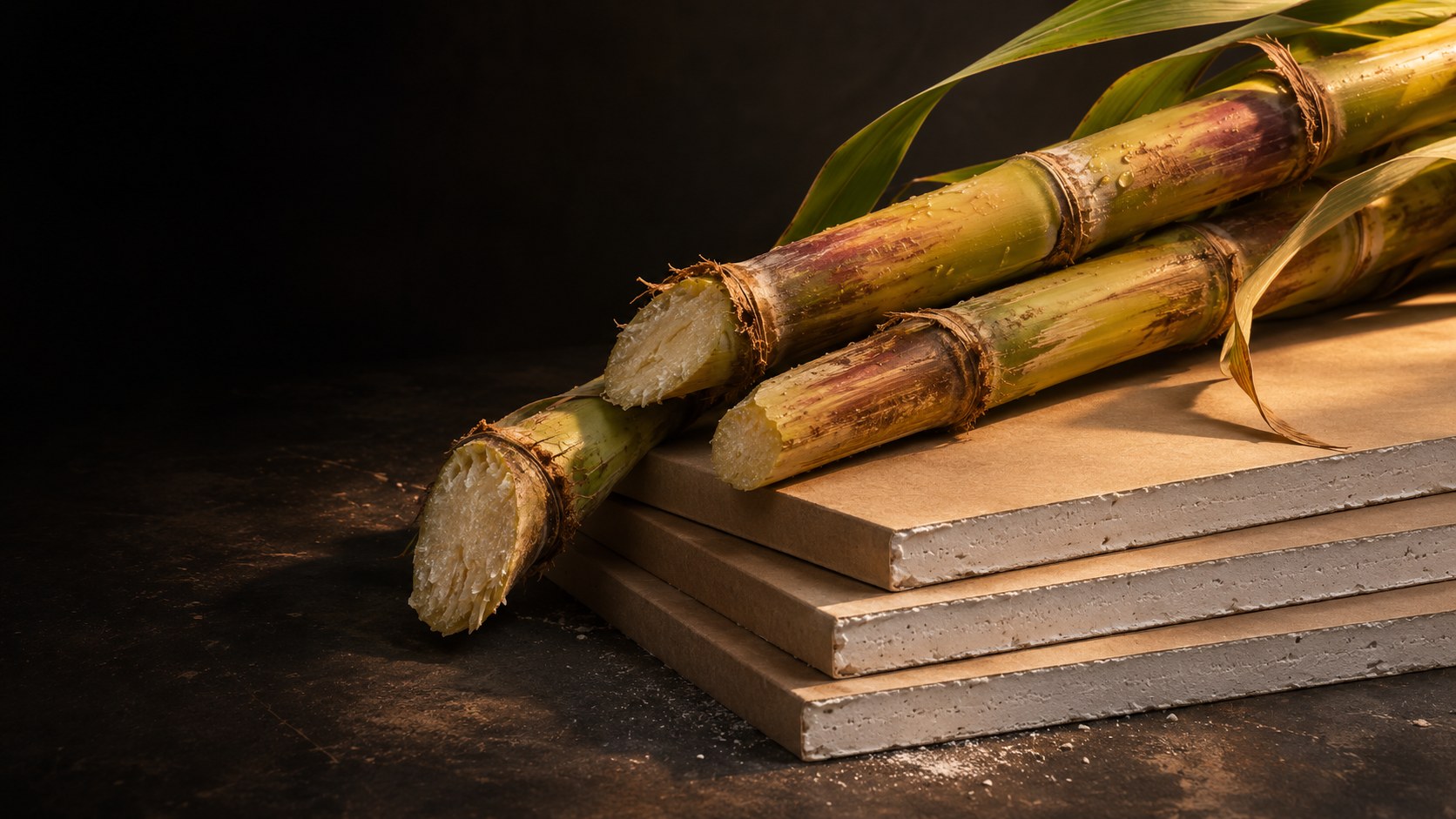
Read the historyIllustration · sugar cane and plasterboard
01 / Sugar
From imported sugar to a Pacific milling network
In 1855, Edward Knox founded the Colonial Sugar Refining Company in Sydney. Its first business was refining imported raw sugar. Early profits were strong, but a fall in world sugar prices left the company holding expensive stock. Knox began retaining more profit to build reserves and fund expansion. [1]
CSR moved upstream into crushing cane, with mills on the Clarence River in New South Wales and expansion into Queensland and Fiji. Edward William Knox took over general management in 1880. In his first five years CSR built seven mills and an Auckland refinery. Its Pyrmont refinery opened in Sydney in 1886. The Queensland sugar industry of that era relied heavily on indentured South Sea Islander labour, including workers brought to Australia under coercion. [2] [3] [4]
In 1936, CSR began making fibreboard from waste sugar cane fibre, sold as Cane-ite. A by-product of the mill became a building material, giving CSR a way to diversify beyond sugar. Sugar remained part of the company for decades. In 2010, CSR sold its sugar business, Sucrogen, to Wilmar International. [3] [5]
02 / Plasterboard
How Gyprock found its way into Australian walls
CSR opened its Concord plaster mill in 1942 and introduced Gyprock paper-faced plasterboard to the Australian market in 1947. Factory-made sheets gave builders a faster way to line walls and ceilings in lightweight construction. By the 1970s, CSR had added manufacturing in Queensland, Victoria and Western Australia. [6] [7]
The range grew into wall and ceiling systems with boards for fire resistance, wet areas and acoustic applications, supported by jointing compounds and The Red Book design guide. Gyprock reached the trade through its own trade centres, independent specialist distributors and hardware resellers. [6] [8]
In a 2021 trade mark decision, an IP Australia hearing officer cited evidence of about 40% share for Gyprock products in the Australian plasterboard market and found the mark had a significant reputation for plasterboard. Saint-Gobain completed its acquisition of CSR in July 2024. [10] [11]
03 / The domain mix-up
The checkout was the quickest part
I bought gyprock.supply thinking I’d found a tidy address for a plasterboard supply business. The name was short, and I’d heard “gyprock” used for plasterboard often enough that I treated it like the name of the trade. Click. Bought.
Then came the product research I should have done one tab earlier. Plasterboard is the material. Plastering is the trade. Gyprock is CSR’s brand. I’d picked a shopfront before reading whose name was on the sign.
So the grand opening is a history lesson. There’s no stock to count, and at least the walls are already finished.
04 / Reader mail
Leave a message
Have a correction, a memory of the old mills or a plasterboard story of your own?
References
Sources
- Australian Dictionary of Biography · Sir Edward Knox
- Australian Dictionary of Biography · Edward William Knox
- CSR · 2005 annual report and 150-year history (PDF)
- National Museum of Australia · Islander labourers
- CSR · 2024 scheme booklet, section 8.2 (PDF)
- CSR Gyprock · Product history
- CSR Gyprock · Manufacturing history (PDF)
- CSR Gyprock · Trade centres, distributors and resellers
- Saint-Gobain · Heading for Australia
- Trade Marks Office · GYPREX decision [2021] ATMO 82
- Saint-Gobain · Completion of the CSR acquisition